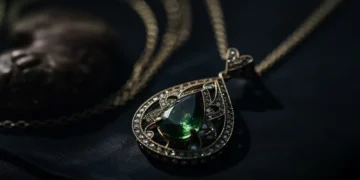


Someone browsing a jade shop in Singapore will often ask what a pendant’s carving means before asking about the stone’s colour or clarity. That instinct is usually the right one, because with jadeite, the carving isn’t just decoration added on top of a good stone; it’s doing as much communicating as the material underneath it.
Why the Carving Isn’t Just Decoration
A skilled carver doesn’t choose a motif first and then find a stone to match it. The process usually runs the other way: the rough stone’s natural colour distribution, translucency, and any inclusions are studied first, and the motif is chosen specifically to work with what’s already there, sometimes hiding a flaw inside a fold of the design, sometimes placing the richest colour exactly where the motif calls for emphasis. Occasionally a carver leaves part of the stone plain and simply polished, a deliberate choice to let the material itself carry the piece without competing against an elaborate design. That’s part of why two pendants carved with the same motif can still look meaningfully different, since the stone underneath is never quite the same twice.
What a Few of the Common Motifs Actually Represent
- Guanyin or Buddha figures: associated with protection, compassion, and spiritual calm, often chosen as a piece meant to be worn for life.
- A ruyi, a ceremonial sceptre shape: tied to having one’s wishes fulfilled, a common choice for milestone gifts.
- A lotus: linked to purity and resilience, since it grows cleanly out of muddy water.
- A pixiu, a mythical guardian creature: associated with protecting wealth, popular among those marking a new business or career step.
- Bamboo: tied to steady growth and resilience under pressure, often chosen for a milestone that took years of effort.
Why the Same Motif Can Mean Something Different to Different Buyers
There’s a long-standing belief that jade is best received as a gift rather than bought for oneself, since a piece given by someone close is thought to carry some of that relationship’s goodwill along with it. That’s part of why a jadeite pendant bought as a gift for a parent, a partner, or a newborn tends to be chosen with the relationship in mind as much as the motif; a Guanyin pendant from a mother carries a different weight than the same motif picked out for a friend’s birthday. None of this changes what the carving technically represents, but it does change what the piece ends up meaning to the person actually wearing it.
A Few Questions Worth Asking Before Choosing One
1. Whether the motif is being chosen for its traditional meaning, its visual appeal, or a specific occasion it’s meant to mark.
2. Who the piece is actually for, since a gifted pendant often carries more weight than one bought for oneself.
3. Whether the setting, a simple bail versus a more elaborate gold mount, suits how often the piece will actually be worn.
How the Stone Itself Still Has the Final Say
Whatever motif ends up chosen, the quality of the jadeite underneath still does most of the work in how a jadeite pendant actually looks and feels over time. Untreated, Type A jadeite keeps its natural colour and texture without any dye or resin filling to prop it up, which matters most once a piece has been worn daily for a few years rather than just examined once under a jeweller’s light. A beautifully carved motif on a lower-grade stone will still dull faster than a simpler design on genuinely good material, which is worth remembering before the carving becomes the only thing being evaluated.
Before the Carving Talks You Into Anything
- A motif’s meaning is real, but it never overrides the quality of the stone it’s carved into.
- The same design can carry a different weight depending on who’s giving it and why.
- A plain, well-polished area left by the carver is often a sign of confidence in the material, not a missed opportunity for more detail.
A jadeite pendant ends up carrying two things at once: a motif chosen with intention, and a story about who gave it and why. Reading only one of those and ignoring the other tends to miss most of what makes a piece worth keeping for decades rather than just a season.
Working out which motif, and which stone, actually fits a particular person or occasion is far easier with pieces in hand than with photos on a screen. Contact Gen.K Jewelry to see the range up close.